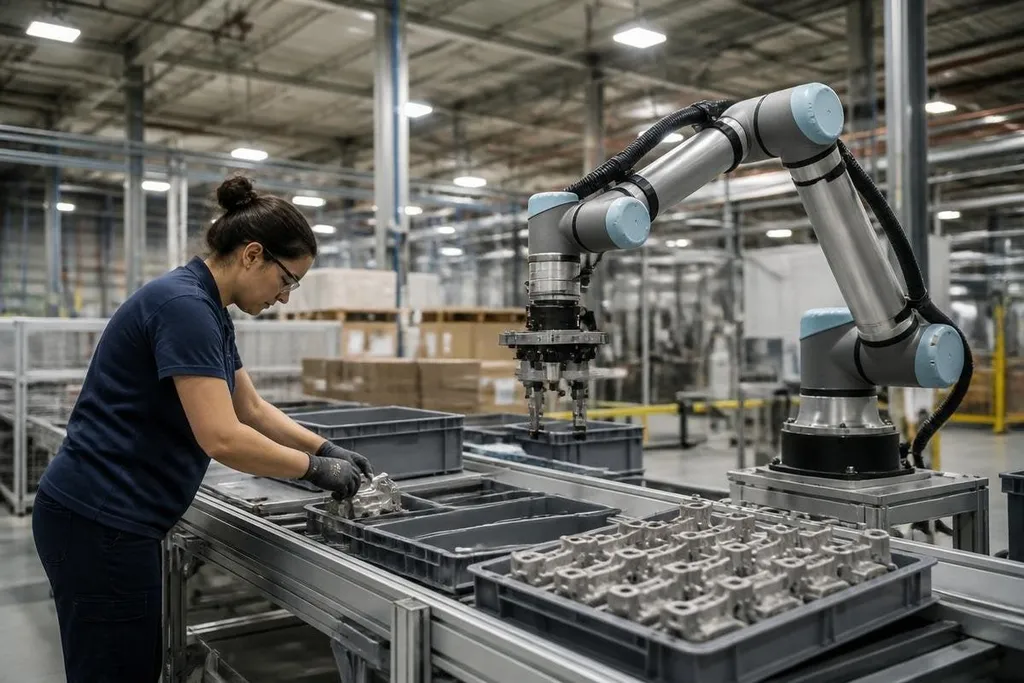
Robots can take on tasks that strain backs, hands, and shoulders, such as lifting boxes, welding parts, and moving loads across a factory. The safety gain depends on where the robot works, how people share the space, and what happens when the system stops.
- Robots can handle repeated lifts and awkward reaches.
- Sensors can stop motion when a person enters a protected area.
- Poor setup can move the hazard from lifting to maintenance or robot access.
Repeated lifting is the clearest use
Many workplace injuries begin with the same motion repeated through a shift. A robot arm can pick a part from one fixed position and place it in another, so a worker spends less time bending, twisting, or reaching across a conveyor.
Palletizing is a common example. The robot stacks cases while a worker loads the conveyor, checks labels, or clears planned faults. The robot takes the repeated load, while the worker keeps tasks that need judgment and visual checks.
That change matters when the load is heavy, the grip is poor, or the work height is low. Its gripper can still drop a part if the load, surface, or grip force is wrong, even though the robot doesn't get tired in the same way a person does.
Robots can remove exposure to dangerous work
Some jobs put people close to heat, fumes, sharp edges, or moving tools. Welding robots can hold a torch through a fixed cycle, while a worker stays outside the cell during the weld.
Inspection robots can also carry cameras into spaces that are hard or unsafe for a person to enter. The robot cell needs physical guards, access doors, and an emergency stop that workers can reach.
Light curtains use a beam of light to detect entry, while area scanners use LiDAR to watch a wider zone. These parts stop the robot or slow it before a person reaches the moving arm.
Safety standards matter here. ISO 10218 covers industrial robot safety, and ISO/TS 15066 covers collaborative robot operation, including limits for contact between people and robot parts. A standard gives the team a method to check the cell; it doesn't remove the need for a site risk assessment.
A site risk assessment needs facts about the robot and the work around it. Robot24.com's robotics safety reporting can place safety claims beside named machines, tasks, and site conditions.
The risk can move to a new task
Removing lifting from a worker's shift can add new work around jams, tool changes, cleaning, and repairs. Those jobs can expose people to stored energy, sharp tooling, unexpected motion, or a load that the robot has left in an unsafe position.
The control system needs a clear stop state. A pause button may stop the program while power remains in the arm, gripper, or conveyor. Lockout and tagout procedures cut the energy source before a person enters the cell for service.
Training also needs to match the real work. An operator who only learns the normal cycle may not know how to respond when a box falls, a sensor fails, or the robot loses its position. Those events should be part of the site check before the cell runs near people.
Collaborative robots need careful limits
A collaborative robot, often called a cobot, is built to work near people under defined conditions. Its force and speed limits depend on the tool, payload, motion, and possible contact points.
A soft-looking arm can still hurt someone if it carries a sharp tool or moves a heavy part. The team must check the complete setup, including the gripper, workpiece, table edges, and paths used by people walking past the cell.
A fence may be safer than shared operation for a fast arm or a heavy load. The right choice depends on the task, not on the label printed on the robot.
A practical safety check before rollout
Use this checklist before the robot takes over a task:
- Name the strain: record the lifts, reaches, twists, and tool contact that cause trouble now.
- Map the cell: mark robot travel, conveyor paths, access doors, emergency stops, and walking routes.
- Test the failure: run blocked sensors, dropped parts, power loss, and a person entering the protected area.
- Lock service energy: set rules for electrical, pneumatic, hydraulic, and stored mechanical energy.
- Train for faults: teach operators what to do during jams, sensor errors, and position loss.
- Check after launch: review near misses, service records, and injury reports once the work pattern changes.
I'd support robot use when it removes a known strain and the new service risks receive the same care. One that lifts the load but leaves people reaching into a live cell has moved the problem, not fixed it.
The useful test is simple: after the robot starts, are workers exposed to fewer hazardous motions, and can the team prove that with its own safety records?